Isabella Bösch-Weiss, hofwärts, Styria
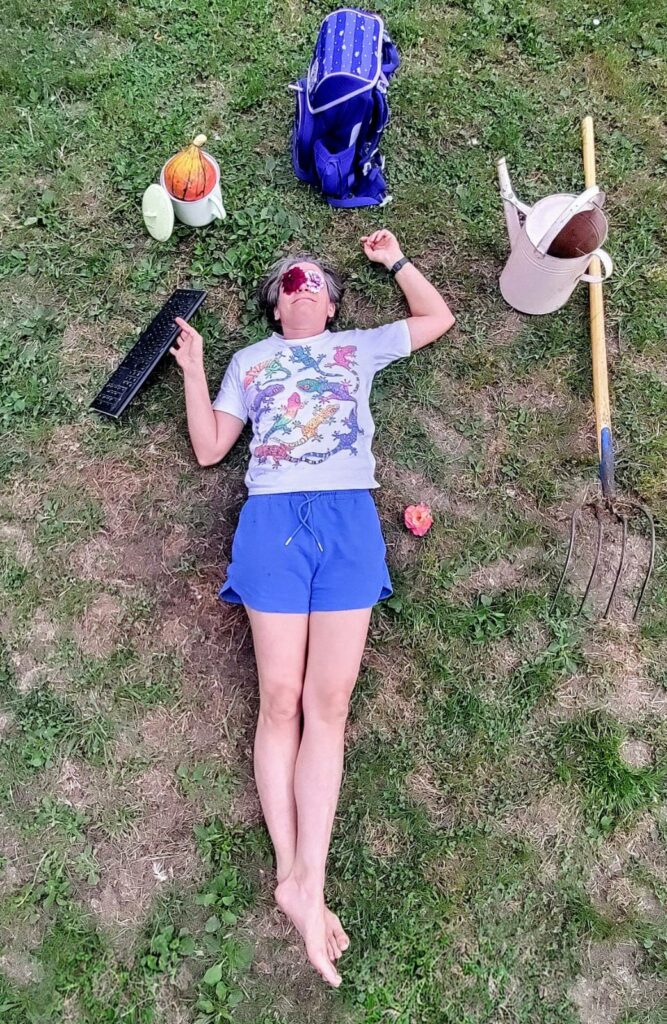
In the picture, you can see a farmer’s wife surrounded by symbols that represent her various main areas of work: The cooking pot and the pumpkin stand for cooking, but also, more broadly, for canning and preserving. The pitchfork and the watering can represent farm work involving animals and the garden. The schoolbag represents children and caregiving, and the laptop represents all the administrative work that one must also manage as a self-employed person or farmer. I’m lying among these symbols, and while these areas of work are always there, I’m choosing to take a break right now. That’s what the flowers represent – in feminism, they often symbolize the beauty in life and the joy of savoring it. So I place the flowers over my eyes so I can enjoy something beautiful.
In this sense, it’s liberating to say: “Certain kinds of work are always there, and they only stop when you say: ‘That’s none of my business right now.’” For me, it’s an important feminist demand to distribute responsibility for (care) work in such a way that every person who bears this responsibility can say often enough: “That’s none of my business right now.”
Our society functions only because of the vast amount of work that women do, some of which goes unpaid. This work is also often invisible. Even to oneself, because one doesn’t frame it as work. If we define feminism as self-determination for all people, then an important first step is likely to recognize which of the things we do constitute work and which constitute self-determined time – even if we have chosen to do them voluntarily.
Fotocredits: Isabella Bösch-Weiss